
Sheena Leven says she learned two important lessons when building her first company, CodeSee. The first lesson was knowing the difference between what businesses need versus what sounds visionary; the second was that the fundamentals always apply, even with new technologies such as AI.
“Security, compliance, reliability, quality, those things don’t just go away for enterprise applications,” she said.
After CodeSee was acquired in 2024, Leven decided that she wanted to build a product that would let business owners, even those without technical backgrounds, build AI applications. She teamed up with AI researcher Sean Robinson, and last October, the two launched Empromptu, an AI service that businesses can use to build AI applications.
Empromptu claims all a user has to do is tell the platform’s AI chatbot what they want — like a new classification app or a generative recommendation app — and the tool will go ahead and build it. It also provides LLM tools to help users if they want to fine-tune any results, and also lets companies add AI features to their own existing code bases.
Leven doesn’t consider it a vibe-coding platform, though she does look to compete with companies like Replit and Lovable.
“Vibe coding is excellent for quick experiments, but Empromptu is what turns those experiments into real software,” she said. Empromptu, she continued, “turns ideas into production features with built-in evaluation, governance, and self-improvement,” she said. “You ship to real customers, with real data and complete control. If vibe coding is the brainstorm, Empromptu is the build.”
On Tuesday, the company said it had raised $2 million in a pre-seed funding round led by Precursor Ventures. Zeal Capital, Alumni Ventures, Founders Edge and South Loop also participated.
Techcrunch event
San Francisco
|
October 13-15, 2026
Leven said the fresh capital will be used for hiring staff and developing new proprietary technology.
The company is hoping to target businesses launching in regulated industries or “deeply complex” areas that involve capturing data and creating applications — software that services hotels, for example.
Overall, Leven hopes that founders feel their businesses can be transformed without having to learn the technical skills to take advantage of the AI revolution.
“It’s just like any other skill,” Leven said. “And the beauty of this skill is that AI can help you learn it along the way.”
This piece was updated to clarify what Empromptu does.
Keep reading the article on Tech Crunch

SoftBank Group and Nvidia are in talks to lead an investment of over $1 billion at a $14 billion valuation in Skild AI, a software company building a foundational robotics model, Reuters reported.
The nearly three-year-old startup was last valued at $4.7 billion in May when it raised $500 million in a round led by SoftBank along with the participation of LG Technology Ventures, Samsung, Nvidia, and others, according to PitchBook data. Skild didn’t immediately respond to a request for comment. SoftBank and Nvidia declined to comment.
Unlike other heavily funded startups, Skild AI is not building proprietary hardware. Instead, it’s developing a robot-agnostic foundation model that can be customized for various types of robots and use cases.
The company unveiled its general-purpose robot model Skild Brain in July with videos showing robots picking up dishes and climbing up and down the stairs. The company has secured strategic partnerships with LG CNS and Hewlett Packard Enterprise to develop its ecosystem.
Investor interest in AI robotics has been steadily growing. Physical Intelligence, another company developing “brains” for a broad range of robots, has reportedly recently raised $600 million at a $5.6 billion valuation led by CapitalG. One investor who evaluated but declined to fund Physical Intelligence told TechCrunch that its model is still in the early stages of development.
In September, Figure, a company developing a humanoid robot, raised more than $1 billion at a massive $39 billion valuation. Meanwhile, 1X, another humanoid robot developer, was in talks to secure as much as $1 billion at a $10 billion valuation, The Information reported several months ago.
Keep reading the article on Tech Crunch

While OpenAI continues to insist that there are currently no ads — or tests for advertising — live in ChatGPT, the company’s chief research officer Mark Chen also acknowledged that the company “fell short” with recent promotional messages and is working to improve the experience.
Chen and other OpenAI executives were responding to posts from ChatGPT’s paying subscribers who complained about seeing promotional messages for companies like Peloton and Target.
In response, the company said it was only testing ways to show apps built on the ChatGPT app platform that it announced in October, with “no financial component” to those suggestions. (One of the users who’d complained initially about the ads responded skeptically, writing, “Bruhhh… Don’t insult your paying users.”)
Similarly, ChatGPT head Nick Turley posted Friday that he was “seeing lots of confusion about ads rumors in ChatGPT.”
“There are no live tests for ads – any screenshots you’ve seen are either not real or not ads,” Turley wrote. “If we do pursue ads, we’ll take a thoughtful approach. People trust ChatGPT and anything we do will be designed to respect that.”
Earlier that same day, however, Chen responded in a more apologetic tone, acknowledging that the controversy isn’t just a matter of user confusion.
“I agree that anything that feels like an ad needs to be handled with care, and we fell short,” he wrote. “We’ve turned off this kind of suggestion while we improve the model’s precision. We’re also looking at better controls so you can dial this down or off if you don’t find it helpful.”
Techcrunch event
San Francisco
|
October 13-15, 2026
Earlier this year, former Instacart and Facebook executive Fidji Sumo joined OpenAI as CEO of Applications and was widely expected to build up the company’s advertising business. However, the Wall Street Journal reported this week that a recent memo from OpenAI CEO Sam Altman declared a “code red,” prioritizing work to improve the quality of ChatGPT and pushing back other products including advertising.
Keep reading the article on Tech Crunch

Sometimes, founding a startup just once isn’t enough.
At least, that seems to be the case with companies like Airtable, Handshake, and Opendoor, which all announced in recent months that they are “refounding.” As reported in The New York Times these announcements are usually tied to new business models or the launch of new AI products.
For example, Airtable said in June that “instead of just adding more A.I. capabilities to our existing platform, we treated this as a refounding moment for the company.
The startup’s co-founder and CEO Howie Liu told the NYT that this is not a pivot because it’s not about changing direction after getting something wrong. Liu said the company considered calling it a relaunch or transformation, but ultimately chose “the language of founding because the stakes feel the same.”
Similarly, Handshake’s chief marketing officer Katherine Kelly said the company is trying to bring startup culture “back into an existing business.” That can also mean harder work — Kelly said handshake told employees they have to be back in the office five days a week, “operating with a pace and number of hours that is meaningful and will help us hit goals.”
Keep reading the article on Tech Crunch
Yoodli, an AI-powered communication training startup, has reached a valuation of more than $300 million — more than triple its level six months ago — as it builds technology meant to assist people rather than replace them with machines.
The valuation increase follows Yoodli’s $40 million Series B round, led by WestBridge Capital with participation from Neotribe and Madrona. It comes after a $13.7 million Series A round announced in May, bringing the startup’s total funding to nearly $60 million.
As AI tools spread into workplaces and fuel fears of automation, Yoodli positions itself differently. The four-year-old, Seattle-based startup uses AI to run simulated scenarios — including sales calls, leadership coaching, interviews, and feedback sessions — and provides users with structured, repeatable practice to improve their speaking skills.
Varun Puri (pictured above, right), who previously worked at Google’s X division and handled special projects for Sergey Brin, co-founded Yoodli with former Apple engineer Esha Joshi (pictured above, left) in 2021. He became aware of communication challenges after moving to the U.S. at 18 and seeing how difficulty expressing ideas or speaking confidently affected students and young professionals from countries such as India — himself included — Puri said in an interview.
Initially, Yoodli was meant to help people practice public speaking — a skill two out of three people struggle with, Puri told TechCrunch, citing internal data. However, the startup soon saw users turning to the platform for interview preparation, sales pitches, and difficult conversations. That shift pushed Yoodli from a consumer-focused product to enterprise training, and it now offers AI role-plays and experiential learning tools for go-to-market enablement, partner certification, and management coaching.
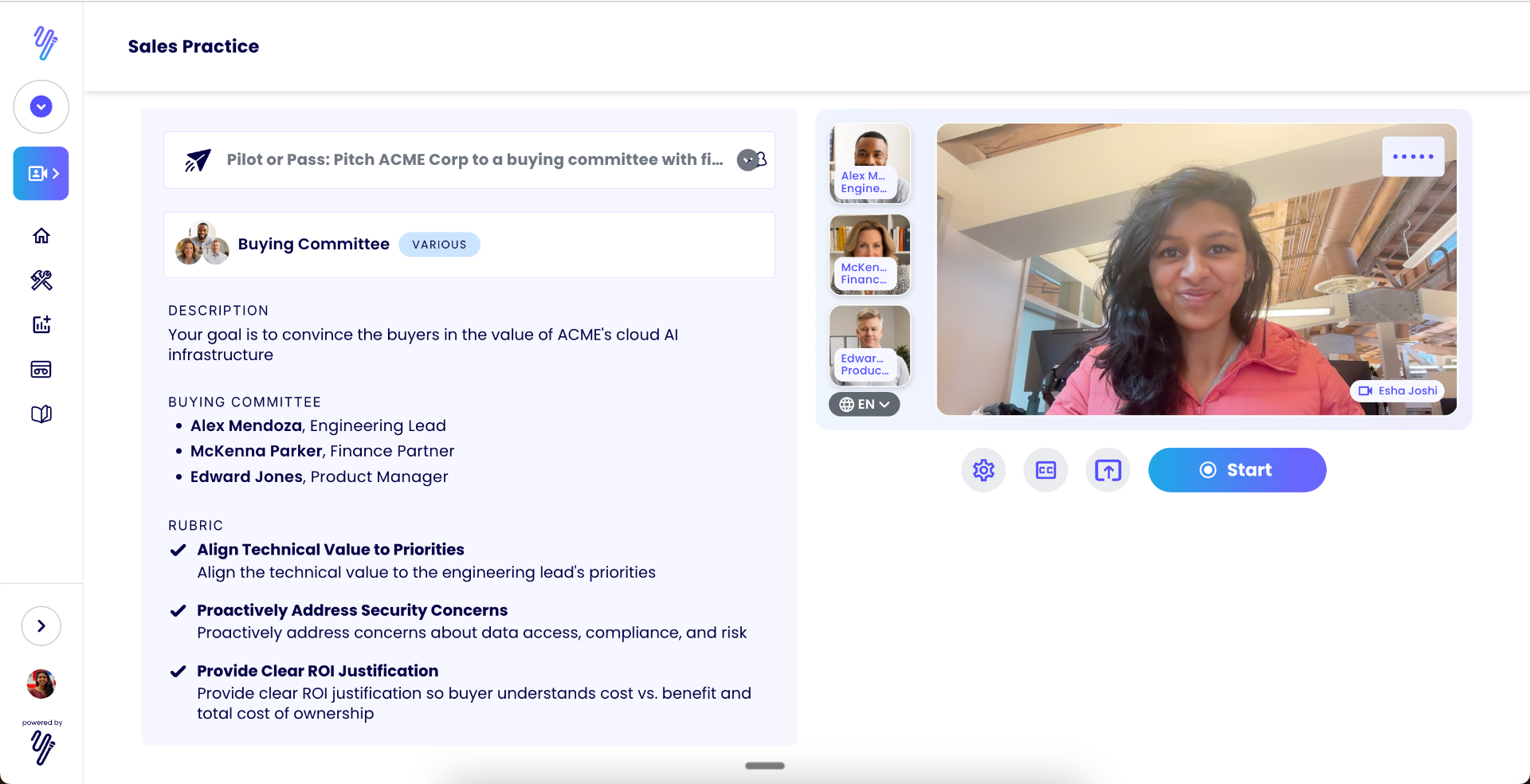
“In the old world, companies would be training people using static, long-form content or passive videos that we’d all watch at 4x-5x speed, just to get the thing done,” said Puri. “But that doesn’t actually mean you’ve learned it.”
Companies including Google, Snowflake, Databricks, RingCentral, and Sandler Sales use Yoodli for employee or partner training. The startup also sells its platform to coaching firms such as Franklin Covey and LHH, which can tailor the system to their own methodology and training frameworks, Puri stated. He added that the tool is not designed to replace human coaches but to keep a human in the loop delivering personalized guidance.
Techcrunch event
San Francisco
|
October 13-15, 2026
“I philosophically believe that AI can get you, let’s call it from a zero to an eight or a zero to nine,” said Puri. “But the pure essence of who you are and how you show up, and your authenticity and vulnerability that a human gives you feedback on will always exist.”
The platform works with multiple large language models, meaning users can run it with models such as Google’s Gemini or OpenAI’s GPT based on their preference. Enterprises can also embed it into their existing software, or users can access it directly through a web browser. The AI supports most major languages, including Korean, Japanese, French, Canadian French, and a list of Indian languages.
Yoodli does not offer a dedicated mobile app, a decision Puri said was made to avoid adding extra steps for users during training sessions.

Puri did not disclose how many people use the platform but said most of Yoodli’s revenue now comes from enterprise customers. He added that between the Series A and B rounds, Yoodli saw a 50% increase in the number of role-plays run on the platform and in the total time users spent practicing. The startup also said it grew its average recurring revenue by 900% over the last 12 months, though it did not provide specific figures.
Yoodli had not planned to raise more funding so soon after its last round but saw unanticipated investor interest, with WestBridge leading the latest raise, Puri said. He noted that strong performance metrics, key customers, and senior hires helped attract investors. The startup has recently hired former Tableau and Salesforce executive Josh Vitello as chief revenue officer (CRO), former Remitly CFO Andy Larson as CFO, and former Tableau chief product officer (CPO) Padmashree Koneti as CPO.
Yoodli is not alone in the market for AI-based communication tools, but Puri told TechCrunch the startup differentiates itself through deep customization and a focus on specific training verticals, allowing companies to tailor the system to their use cases and coaching methods.
The Seattle-headquartered startup has about 40 employees. Puri said the latest funding will be used to expand Yoodli’s AI coaching, analytics, and personalization tools, and to grow its presence in enterprise learning and professional development. The company also plans to hire across product, AI research, and customer success, and to expand into markets in the Asia-Pacific region while deepening its footprint in the U.S.
Keep reading the article on Tech Crunch

Aaru, a startup that provides near-instant customer research by using AI to simulate user behavior, has raised a Series A led by Redpoint Ventures, according to three people familiar with the deal.
The funding round included different valuation tiers, these people said. Although some equity was acquired at a $1 billion valuation, a lower valuation for other investors resulted in a blended valuation below $1 billion, according to people familiar with the deal. Multi-tier valuations within the same round are an unusual mechanism in venture capital, but investors say they are becoming increasingly common for desirable AI startups in the current market. This approach allows the company to report a higher “headline” valuation while simultaneously offering better terms to specific investors.
Aaru and Redpoint Ventures didn’t respond to a request for comment.
The exact round size couldn’t be learned, but one person said that it is above $50 million. Another source said that the startup is growing quickly, but its annual recurring revenue (ARR) is still below $10 million.
Aaru was founded in March 2024 by Cameron Fink, Ned Koh, and John Kessler, according to their LinkedIn profiles.
The startup’s prediction model generates thousands of AI agents that simulate human behavior using public and proprietary data. Aaru replaces traditional market research methods, which generally include surveys and focus groups, by using agents to predict how groups in specific demographics or geographies will respond to future events.
The company’s customer partners include Accenture, EY, Interpublic Group, and political campaigns. Last year, Aaru AI’s polling methodology accurately predicted the outcome of the New York Democratic primary, according to reporting by Semafor.
Techcrunch event
San Francisco
|
October 13-15, 2026
Aaru competes with other social simulation startups, including CulturePulse and Simile, as well as startups that apply AI to query humans about their product preferences, such as Listen Labs, Keplar, and Outset.
The startup raised an undisclosed amount of seed and pre-seed capital from investors, including A*, Abstract Ventures, General Catalyst, Accenture Ventures, and Z Fellows, according to people familiar with the deal and PitchBook data.
Keep reading the article on Tech Crunch