
Texas Attorney General Ken Paxton is vowing to (somewhat) crack down on AI data center buildout if he wins his bid for Senate.
The Republican candidate just unveiled a four-point plan he is calling the “Texas First Data Center Plan.” The proposal, in vague terms, includes authoring legislation to prohibit data centers from using Chinese tech and holding data center companies “criminally liable” for empowering AI chatbots that have been determined to undermine the safety of children.
Paxton is running against State Rep. James Talarico for a once-reliably Republican seat representing Texas in the U.S. Senate. But Paxton is facing a tough run, not just because Talarico is polling rather well, but also due to his own scandal-plagued past. The data center platform could be a way for Paxton to gain back some of the support he may have lost to Talarico, considering the trajectory of public sentiment and Talarico’s own longer-standing promise to crack down on data centers. Talarico—whose platform includes voting to repeal Texas’ data center sales tax exemption, requiring data centers to reuse a fixed amount of water, and granting local communities the power to veto data center projects—called Paxton’s plan “a sad attempt to reverse course,” per Fox News.
The public has grown dramatically anti-AI and data centers in just the past few months alone, and the criticism is coming from all sides of the political spectrum. Many public figures, including but not limited to the Pope, have raised concerns about the unprecedented speed at which the technology is developing, and the toll it’s taking on things like the economy, global warfare, and the mental health of its frequent users. The public is also unhappy about the impact data centers are having on local communities, most of them rural, who have been plagued by rising utility bills, water shortages, and above-average air and noise pollution.
That fast-accelerating pace is felt particularly intensely in Texas, a state that is only second to Virginia in the number of data centers it hosts, per Data Center Map. Major companies have also made the state home to their most ambitious, flagship AI infrastructure projects, from OpenAI’s Stargate in Abilene to SpaceX’s Terafab in Austin, meant to produce chips to be used in space to power owner Elon Musk’s dreams of a massive orbital data center colony.
As part of his four-point plan, Paxton is also vowing to co-sponsor the DATA Act, proposed by Arkansas Sen. Tom Cotton and aiming to loosen federal regulation to incentivize data centers to build their own off-grid power supplies, and promises to “fiercely advocate” for Governor Greg Abbott’s own data center regulations.
In a TV appearance on Sunday, Texas Governor Greg Abbott said the rising anti-AI data center sentiment was justified, saying that the AI companies “basically dug their own grave for the problem that’s been caused for them, and that’s why they got the backlash they deserve.” Earlier this month, Abbott directed the Public Utility Commission of Texas and the state’s power grid operator to audit data center projects that want to connect to the grid.
But the heavily MAGA-aligned Republican politicians are likely to face problems in their AI messaging. The public is souring on data centers, and with the midterm elections looming in November, the politicians would do well to curry public favor. Artificial intelligence is becoming such a determining electoral issue that NBC News has introduced it into its public polling.
But the politicians’ allegiance to Trump also matters, and not only is the President still staunchly in favor of the AI industry and its unprecedented data center buildout, but he also takes any opposition to heart. The administration has repeatedly worked to reduce obstacles standing in the way of the AI industry. Just last month, the Environmental Protection Agency said that power plants would not be subject to some environmental pollution restrictions if they are not connected to the public grid.
That support was once again voiced on Sunday. In an interview with his former fixer Michael Cohen, Trump claimed that data centers don’t take power from the grid because they’re building “the most beautiful, you’ve never seen power plants like this,” and that any community that refuses a data center would be “making a mistake” because they create “tremendous amounts of jobs and money.”

How do you keep an antitrust-curious president from sinking your M&E deal? This is reportedly how.
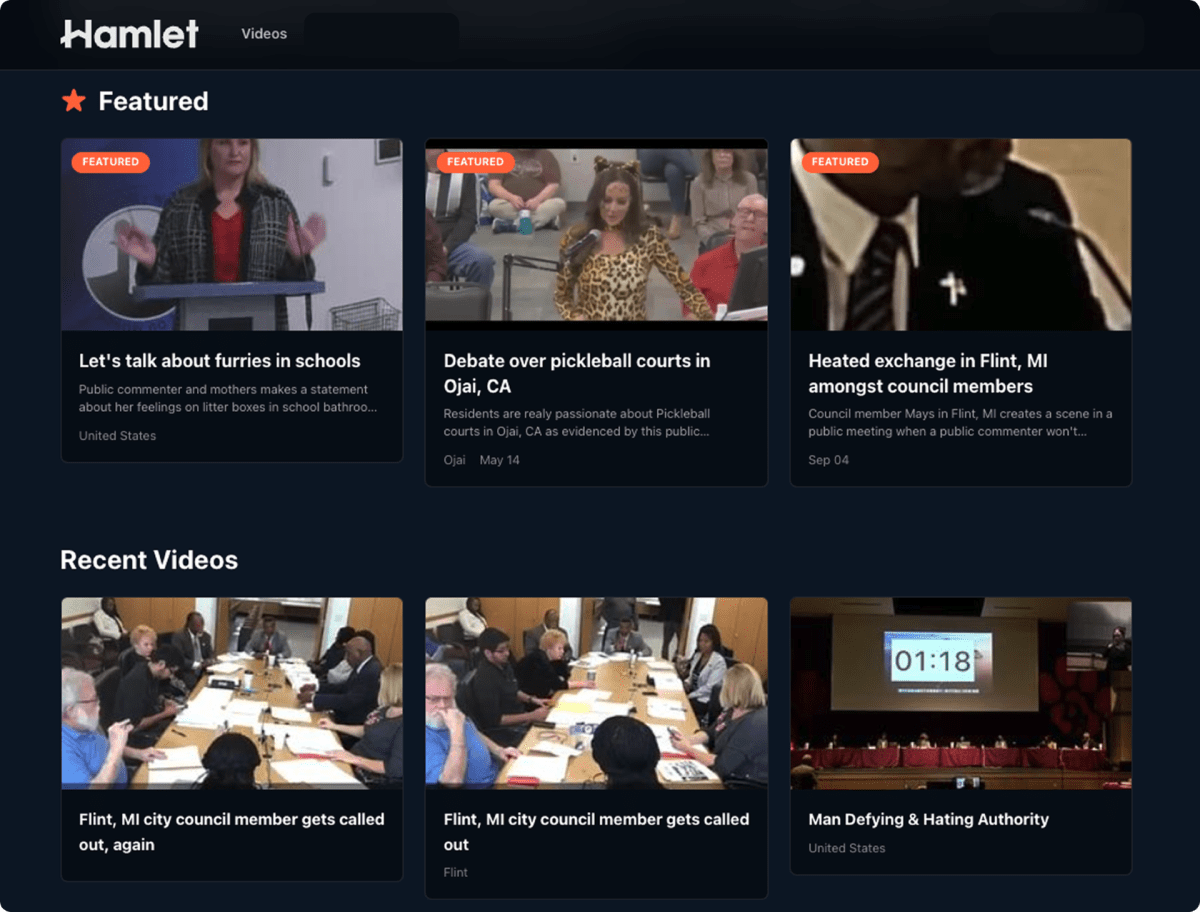
The launch of Hamlet was quite personal for Sunil Rajaraman.
Back in 2022, he ran for city council in a small California town. He lost, but the moment forever changed the way he saw the place — and local governments, for that matter.
“I was trying to become a better candidate,” he recalled to TechCrunch. “I wanted to understand how my city actually worked, what decisions had been made, why, who said what. And I couldn’t figure it out. It’s a total black box, and almost intentionally opaque.”
Since COVID, towns across the nation have started recording and posting their city meetings online. That gave Rajaraman an idea: a company that helped people understand what was happening in local governments. That same year, in 2022, he launched Hamlet to do just that.
“We use AI to process thousands of hours of city council and planning commission meeting videos and turn them into intelligence they can actually use,” he said. He said these videos are better than meeting minutes because those documents are just someone’s interpretations of what happened. “The video doesn’t lie.”
At first, he thought it would be a media company, but then real estate developers and political action committees started reaching out. Rajaraman realized that private companies have to deal with local governments, too, and they also want more insight into what is happening in those city council meetings.
For enterprise customers, the company helps track agendas and alerts them when relevant topics are addressed across target cities. It also synthesizes what happened after meetings, so they don’t have to watch hourslong videos, and it lets them search the video archive to see, for example, when and how a competitor was mentioned in a local government setting.
Techcrunch event
San Francisco
|
October 13-15, 2026
Hamlet has raised around $10 million in venture funding to date, from backers including Slow Ventures, Crosslink Capital, Banana Capital, and Kapor Capital. “We want to become the ‘Bloomberg’ of this space, so to speak,” Rajaraman said.
On Friday, Rajaraman announced he is expanding the company to launch Hamlet TV as a way to help keep regular citizens informed of what is happening inside their governments. The streaming channel is on TikTok, YouTube, AppleTV, and Instagram, and will spotlight important moments from council, commission, and school board meetings.
Rajaraman said his company has processed thousands of hours of government meetings for government customers.
“We’ve seen meetings that have lasted 15-plus hours without recess,” he said. He and his team started curating funny moments from those meetings, and they thought it was a good idea to use humor to get people more invested in the U.S. democracy. “If you show people procedural videos, they are just not going to care. But if you show them the funny stuff, they’ll watch.”
The most surprising thing he and his team have seen so far on Hamlet TV has been someone dressing up as a cockroach to address their city council about a pest problem. But it’s not the funny stuff that surprises him, he said. “It’s how consequential these meetings are and how invisible they remain.”
He cited an example from earlier this year when the Tucson city council rejected Amazon’s $3.6 billion data center. He said that the decision came after months of planning, but only a few people likely watched those videos to understand why it happened.
This isn’t Rajaraman’s first time running a business — or a media outlet. He co-founded the analytics platform Scripted and was twice the Entrepreneur in Residence at Foundation Capital. He also ran a publication called The Bold Italic and then sold it to Medium.
He knows Hamlet TV probably won’t be a moneymaker and reiterated that he’s doing this to get people more involved with the state of the country’s democracy. He also plans to give away the Hamlet tool to local journalists for free. “Data is great, but context matters so much,” he said.
Next, the Hamlet company is looking to work with government affairs, advocacy organizations, and renewable energy developers. “Democracy works better when people are watching,” he said. “We’re trying to make watching possible.”
Keep reading the article on Tech Crunch