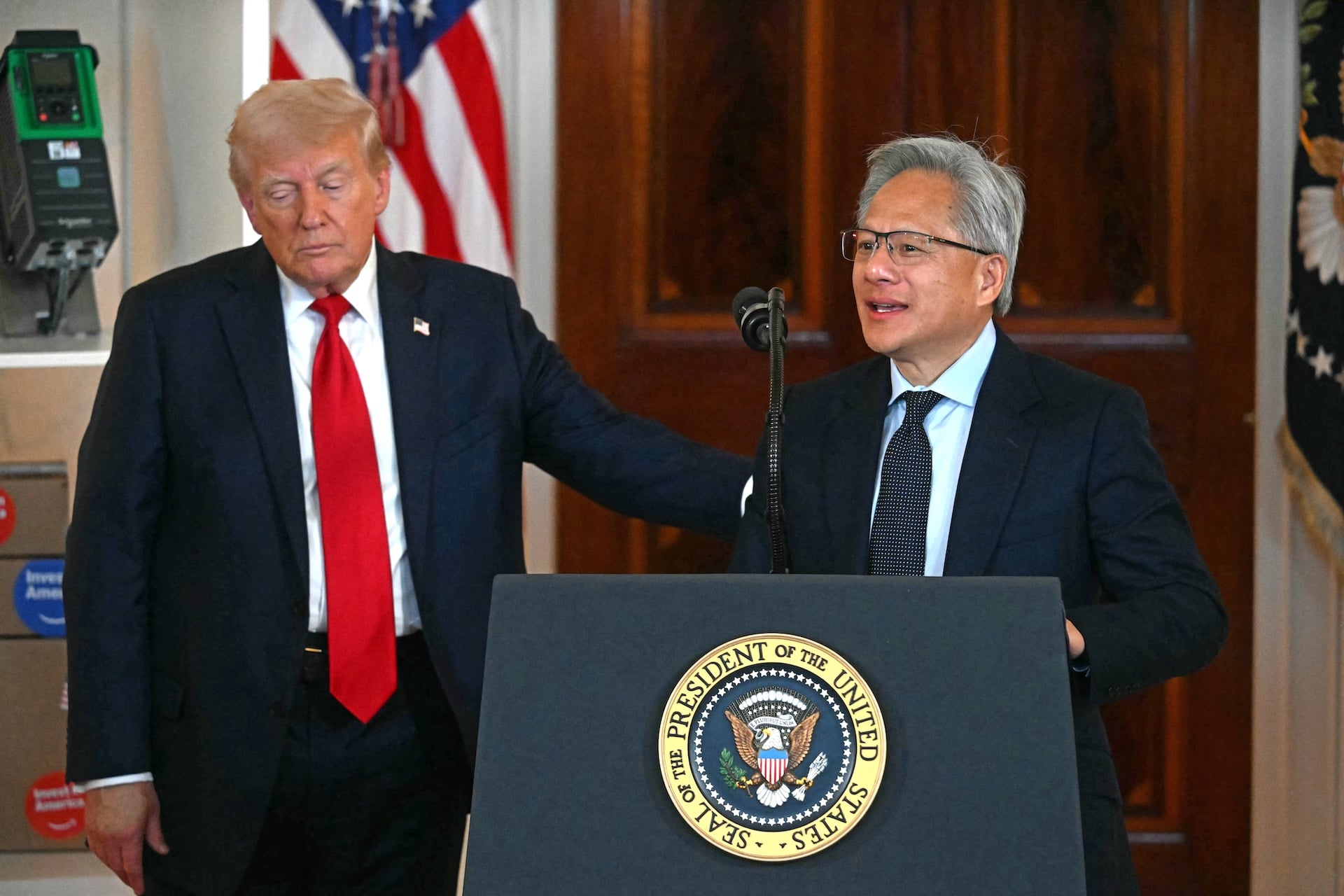
The U.S government will take a 25% cut, according to the president.
SoftBank Group and Nvidia are in talks to lead an investment of over $1 billion at a $14 billion valuation in Skild AI, a software company building a foundational robotics model, Reuters reported.
The nearly three-year-old startup was last valued at $4.7 billion in May when it raised $500 million in a round led by SoftBank along with the participation of LG Technology Ventures, Samsung, Nvidia, and others, according to PitchBook data. Skild didn’t immediately respond to a request for comment. SoftBank and Nvidia declined to comment.
Unlike other heavily funded startups, Skild AI is not building proprietary hardware. Instead, it’s developing a robot-agnostic foundation model that can be customized for various types of robots and use cases.
The company unveiled its general-purpose robot model Skild Brain in July with videos showing robots picking up dishes and climbing up and down the stairs. The company has secured strategic partnerships with LG CNS and Hewlett Packard Enterprise to develop its ecosystem.
Investor interest in AI robotics has been steadily growing. Physical Intelligence, another company developing “brains” for a broad range of robots, has reportedly recently raised $600 million at a $5.6 billion valuation led by CapitalG. One investor who evaluated but declined to fund Physical Intelligence told TechCrunch that its model is still in the early stages of development.
In September, Figure, a company developing a humanoid robot, raised more than $1 billion at a massive $39 billion valuation. Meanwhile, 1X, another humanoid robot developer, was in talks to secure as much as $1 billion at a $10 billion valuation, The Information reported several months ago.
Keep reading the article on Tech Crunch
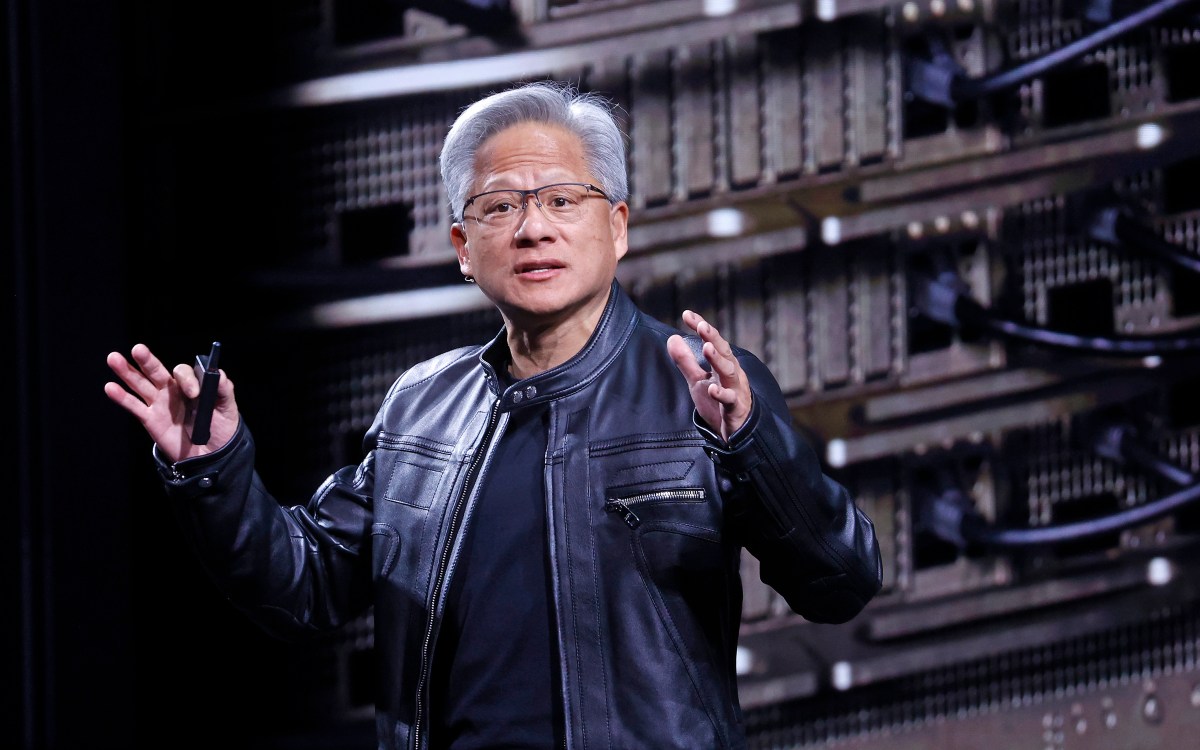
Advanced Nvidia AI chips can head back to China after all.
The Department of Commerce will allow Nvidia to ship H200 chips to China, as originally reported by Semafor, to approved customers in the country. The U.S. will take a 25% cut of these sales, CNBC reported.
H200 chips are much more advanced than the H20 chips Nvidia developed specifically for the Chinese market, but the company would only be able to send H200s that are roughly 18 months old, Semafor reported.
“We applaud President Trump’s decision to allow America’s chip industry to compete to support high paying jobs and manufacturing in America. Offering H200 to approved commercial customers, vetted by the Department of Commerce, strikes a thoughtful balance that is great for America,” an Nvidia spokesperson told TechCrunch.
The news report comes a week after U.S. Commerce Secretary Howard Lutnick said the decision on exporting these H200 chips to China was in President Donald Trump’s hands.
The decision to send these chips to China conflicts with Congressional concerns about national security.
Pete Ricketts, a Republican senator from Nebraska, and Chris Coons, a Democratic senator from Delaware, introduced a bill on December 4 that would block the export of advanced AI chips to China for more than two years.
Techcrunch event
San Francisco
|
October 13-15, 2026
The Secure and Feasible Exports Act (SAFE) Chips Act would require the Department of Commerce to deny any export license on advanced AI chips to China for 30 months. It’s unclear when legislators will vote on the proposed bill especially now that the Trump administration has given the green light to sell the H200 chips.
While Congress has long been clear about sending advanced AI chips to China — on both sides of the aisle — President Trump has waffled on whether or not to allow the exports.
The Trump administration hit chip companies like Nvidia with licensing requirements to send their chips to China in April before it formally rescinded a Biden administration diffusion rule that would have regulated AI chip exports in May. Over the summer, the U.S. government signaled that companies would be able to start sending chips to China as long as the government got a 15% cut of all revenue, as chips became a bargaining tool in trade talks with China.
However, by that point, the market for U.S.-developed chips in China was strained.
In September, China’s internet regulator, the Cyberspace Administration of China, banned domestic companies from buying Nvidia’s chips, leaving companies in the country to rely on less advanced domestic chips from Alibaba and Huawei.
On Monday, Trump said that Chinese president Xi Jinping “responded positively” to the latest H200 news in a Truth Social post.
This story was updated on December 8 when the proposed decision was confirmed.
Keep reading the article on Tech Crunch
Welcome back to TechCrunch Mobility — your central hub for news and insights on the future of transportation. To get this in your inbox, sign up here for free — just click TechCrunch Mobility!
Another week, another round of announcements about robotaxis either launching or planning to in cities.
Let’s take stock. Waymo started testing its autonomous vehicles (with a safety monitor) in Philadelphia and will start manual driving to collect data in Baltimore, St. Louis, and Pittsburgh; Uber and Avride launched a robotaxi service in Dallas that will initially include a human safety operator behind the wheel; and the California Department of Motor Vehicles released revised rules that would allow companies to test and eventually deploy self-driving trucks on public highways in the state.
Autonomous vehicle tech is scaling and the pace is quickening. But should it?
As autonomous vehicle tech percolates into the cityscape, so has the criticism and challenges. A couple of recent incidents illustrate this point.
The National Highway Traffic Safety Administration has asked Waymo for more information about its self-driving system and operations following reports from the Austin School District that its robotaxis illegally passed school buses 19 times this year. The agency already opened an investigation into Waymo’s performance around school buses.
Then there is KitKat, the bodega cat that died after a Waymo robotaxi ran him over on October 27. The company was already facing criticism over the event. And now it might escalate thanks to new video. The NYT tracked down surveillance video that shows a woman crouching beside the Waymo trying to lure KitKat to safety before the vehicle suddenly pulled away.
Techcrunch event
San Francisco
|
October 13-15, 2026

A lot of changes have been happening at Lucid Motors recently, according to some little birds.
As many of you already know, the company has lost a number of top executives, including former CEO and CTO Peter Rawlinson and most recently, chief designer Eric Bach. Lucid, which is in the middle of ramping up production of its Gravity SUV, has patched some of these vacancies with a mix of internal promotions and outside hires.
And the changes keep coming. A few little birdies told us this week that a handful or more of top managers on its software and electrical teams were let go, including two senior directors who started with Lucid around a decade ago.
Got a tip for us? Email Kirsten Korosec at kirsten.korosec@techcrunch.com or my Signal at kkorosec.07, or email Sean O’Kane at sean.okane@techcrunch.com.

Electric aircraft maker Beta Technologies, which went public last month, is carving out a nice little supplier business for itself. Which is fitting since the Vermont-based company is aiming to be an OEM to the aviation sector.
The company locked in a deal to supply air taxi company Eve Air Mobility with its electric pusher motors. Beta says the agreement is a potential 10-year opportunity valued at $1 billion.
Of course, “potential” is an important hedge. That $1 billion is not guaranteed, even if shareholders translated it as such (stocks popped 8% following the news). Still, Beta is finding a near-term revenue path as it continues to work toward the commercial certification of its electric aircraft with the Federal Aviation Administration.
The company also reported its third-quarter earnings this week. Beta saw its revenue more than double to $8.9 million from the same quarter last year. Its net losses have also grown. Beta reported net losses of $452 million in the third quarter, a more than fivefold increase from the same year-ago period.
Other deals that got my attention …
Autolane, a Palo Alto-based startup developing the “air traffic control” for autonomous vehicles, raised $7.4 million in a round led by VC firms Draper Associates and Hyperplane.
Element Fleet Management, an automotive fleet manager, acquired San Francisco-based connected vehicle payments company Car IQ. The terms weren’t disclosed, but sources with information on the deal told TechCrunch the acquisition price was $80 million. History lesson: back in 2024, Canada-based Element Fleet Management acquired fleet optimization software startup Autofleet for $110 million.
ExploMar, a China-based developer of electric propulsion systems for boats, raised $10 million in a Series A round. The investment was jointly led by private equity funds and a listed company in China (not disclosed), with existing shareholder DCM Ventures continuing to participate.
Heven AeroTech, a startup developing hydrogen-powered drones, raised $100 million in a Series B round led by American quantum computing company IonQ. The company’s post-money valuation is now more than $1 billion. Texas Venture Partners also participated.
Wayve, the buzzy U.K. self-driving startup backed by Microsoft, Nvidia, and SoftBank Group, acquired German startup Quality Match, which analyzes data used to train AI models for automated driving. Terms weren’t disclosed.

Amazon is considering ending its long-standing contract with the United States Postal Service and building out its own competing nationwide delivery network.
Tesla owners can text and drive with the latest version of the company’s Full Self-Driving (Supervised) driver-assistance software, despite the fact that it’s illegal to do so in most states.
Grand Theft Auto Online has added robotaxis from a fictional-yet-familiar company dubbed “KnoWay,” whose sole purpose appears to be wreaking havoc.
Nvidia announced Alpamayo-R1, an open reasoning vision language model for autonomous driving research.
TechCrunch’s Europe-based reporter Anna Heim gives an inside look at a drone delivery partnership in Finland.
The Trump administration said it will lower fuel economy standards for cars and light trucks sold in the United States, arguing it will make vehicles more affordable. There’s a trade-off, though. Consumers could end up paying more for gas.
The reduction essentially brings vehicles below what they’re achieving already. The proposal would roll fleet-wide fuel economy to 34.5 miles per gallon for 2031 model-year cars. The previous fuel economy standard, set under the Biden administration, mandated fuel economy of 50.4 mpg by 2031. In 2024, automakers had to average 30.1 mpg across their fleets, which they beat, delivering 35.4 mpg, according to CAFE calculations.
Back before Thanksgiving, we did a poll in the Mobility newsletter asking, “When do you expect robotaxis to reach a tipping point of mass adoption that will affect how people move from Point A to Point B?” Most readers picked “before the end of the decade,” which received 47.2% of the vote, followed by the “2030s.” Based on your votes, there appears to be low confidence that 2026 will be the year of the tipping point.
Sign up for the Mobility newsletter to participate in our polls!
Keep reading the article on Tech Crunch