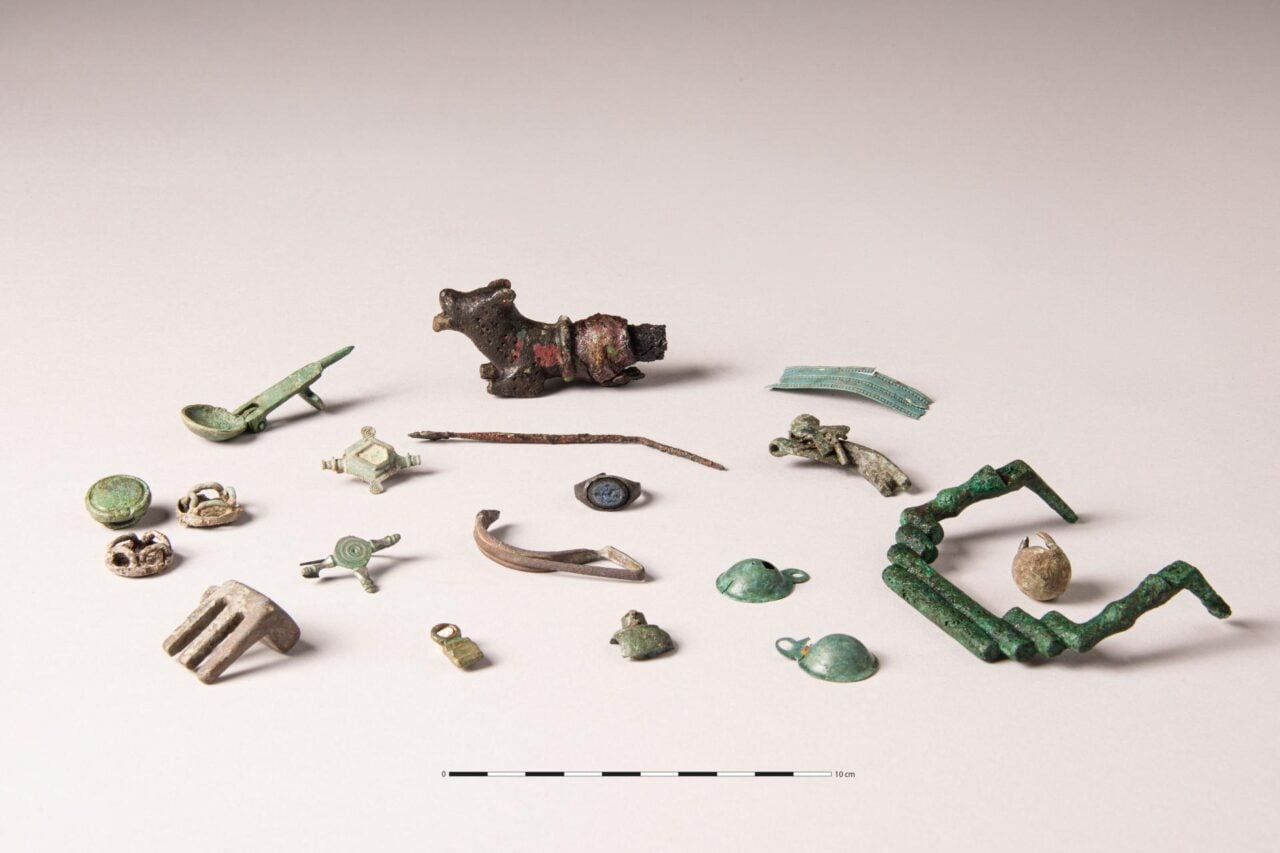
 A set of metallic Gallo-Roman offering furniture. Credit: Emmanuelle Collado/INRAP
In 2019, French archaeologists unearthed an ancient Celtic settlement from the third century BCE. Things took somewhat of a grim turn when the team, while cataloging metal artifacts from the site, found some remarkably well-preserved shackles—likely relics from the region’s slave trade.
The French National Institute for Preventive Archaeological Research (INRAP) published the results in a recent announcement (translated via Google Translate). In the statement, INRAP reported that the settlement of Allonnes turned up a rich collection of metal objects. In addition to the iron shackles, there were weapons, coins, jewelry, and more, made of iron and copper alloys. The team suspects that the settlement was home to a lively community of Gaulish artisans and merchants—and, in the shadows, individuals who, at the time, were “mere objects of property,” it noted in the statement.
A set of metallic Gallo-Roman offering furniture. Credit: Emmanuelle Collado/INRAP
“The Allonnes excavation yielded a rich assemblage of metal objects—remarkable for their number, variety, and quality, despite some degradation caused by soil acidity,” Thierry Lejars, director at the French National Centre for Scientific Research, said in an accompanying booklet (translated via Google Translate).
Until its conquest by the Roman Empire around 50 BCE, the Gauls occupied most of modern Western Europe. In a 1987 essay, historian Ramsay MacMullen explained that the evidence for slavery in Gaul is “almost exclusively epigraphic.” It’s highly likely that the Gaul elites kept enslaved people to maintain their luxurious homes, but in terms of physical labor, such as in agriculture, the evidence is “scanty.”
The INRAP announcement echoed this sentiment. Generally speaking, “races relating to the poorest members of Gallic society, and especially those of servile populations, remain invisible,” the INRAP noted. Therefore, the discovery of the metal shackles is “extremely rare” for this particular period and territory of the Gauls.
“The identification of shackles and weapons suggests a hierarchical social structure comprising a dominant class and a subordinate one [or imprisoned or enslaved people],” Lejars said.
And the details are quite gruesome. The wrist shackles are around 2.4 inches (6 centimeters) in diameter, which could easily mean they were for women or children. The ankle shackles weighed roughly 2.2 pounds (1 kilogram). The team hypothesizes that the enslaved could have been war prisoners, convicts, or individuals with unpaid debts.
That said, the settlement revealed other aspects of Gallic society, even after its Roman conquest. For instance, the settlement’s location in Allonnes would have placed it at a “particularly advantageous position for trade,” according to the statement. This would explain the sheer abundance of metal relics, as well as semi-finished products and scrap metal. The area also appears to have housed a sanctuary for religious rituals that endured long after the Roman conquest of the Gauls.
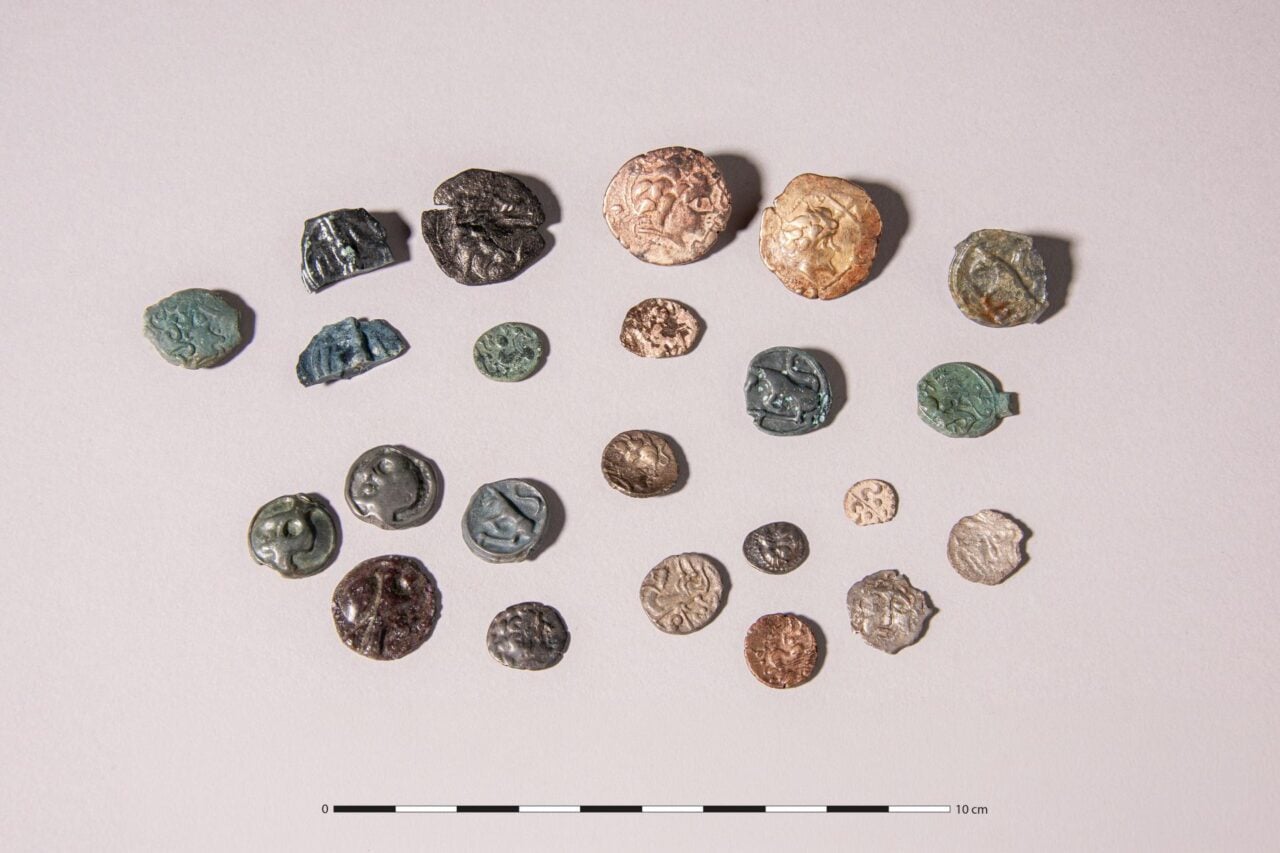 A sample of Gallic coins, some of which have been deliberately mutilated. Credit: Emmanuelle Collado/INRAP
Fascinatingly, a significant portion of weapons and trinkets were deliberately mutilated. The team believes this “reveals a religious intent—stripping away the object’s commercial function to consecrate it to the sacred, thereby ensuring the offering’s permanence,” Isabelle Bollard-Raineau, a regional curator at Pays de la Loire in France, said in the booklet.
The results were initially presented to the local community in a conference, as well as school visits over the last academic year for public education.