
SoftBank Group and Nvidia are in talks to lead an investment of over $1 billion at a $14 billion valuation in Skild AI, a software company building a foundational robotics model, Reuters reported.
The nearly three-year-old startup was last valued at $4.7 billion in May when it raised $500 million in a round led by SoftBank along with the participation of LG Technology Ventures, Samsung, Nvidia, and others, according to PitchBook data. Skild didn’t immediately respond to a request for comment. SoftBank and Nvidia declined to comment.
Unlike other heavily funded startups, Skild AI is not building proprietary hardware. Instead, it’s developing a robot-agnostic foundation model that can be customized for various types of robots and use cases.
The company unveiled its general-purpose robot model Skild Brain in July with videos showing robots picking up dishes and climbing up and down the stairs. The company has secured strategic partnerships with LG CNS and Hewlett Packard Enterprise to develop its ecosystem.
Investor interest in AI robotics has been steadily growing. Physical Intelligence, another company developing “brains” for a broad range of robots, has reportedly recently raised $600 million at a $5.6 billion valuation led by CapitalG. One investor who evaluated but declined to fund Physical Intelligence told TechCrunch that its model is still in the early stages of development.
In September, Figure, a company developing a humanoid robot, raised more than $1 billion at a massive $39 billion valuation. Meanwhile, 1X, another humanoid robot developer, was in talks to secure as much as $1 billion at a $10 billion valuation, The Information reported several months ago.
Keep reading the article on Tech Crunch

Meta is developing new mixed reality glasses under the codename Phoenix, according to Business Insider — but their release date has been pushed back from the second half of 2026 to the first half of 2027.
The Facebook parent company already sells VR headsets and Ray-Ban smart glasses, but these glasses sound a bit different; their format factor would reportedly be similar to the Apple Vision Pro, with a puck-like power source.
BI says it’s seen memos from Meta executives announcing the delay, apparently after meetings in which CEO Mark Zuckerberg told them to take more time to make the business sustainable and deliver higher quality experiences.
The company’s metaverse leaders Gabriel Aul and Ryan Cairns reportedly wrote that the delay is “going to give us a lot more breathing room to get the details right.”
Bloomberg reported earlier this week that Meta plans to slash its metaverse budget by up to 30%.
Keep reading the article on Tech Crunch

Limitless, the AI startup formerly known as Rewind, has been acquired by Meta, the company announced Friday on its website. The company, which made an AI-powered pendant to record your conversations, says it will no longer sell its hardware devices and will maintain support for its existing customers for a year.
Customers will no longer have to pay a subscription fee and will be moved to the Unlimited Plan for the time being. Other functionality will be wound down, including its non-pendant software “Rewind,” which recorded users’ desktop activity and turned it into a searchable record.
The startup, founded by Brett Bejcek and Dan Siroker, the co-founder and former chief executive of Optimizely, pivoted to become an AI device maker last year, offering its Limitless pendant for $99. The wearable could attach to your shirt like a wireless mic or be worn like a necklace. The device is one of several AI hardware devices on the market, including another (not very well-received) AI pendant known as Friend.
According to Limitless’ announcement, the company shares in Meta’s vision to “bring personal superintelligence to everyone,” which includes building AI-enabled wearables. (Meta is focused for now on AR/AI glasses, like its Ray-Ban Meta and Oakley Meta, and its in-lens AI glasses, the Meta Ray-Ban Display.) Limitless said it will help bring that vision to life — which likely means supporting Meta’s existing products, not helping Meta add an AI pendant to its lineup.
The company hinted that the increased competition in the market made it difficult for it to compete, especially as the larger players like OpenAI and Meta are developing their own hardware devices, too.
“When we started Limitless five years ago, the world was very different,” wrote Siroker in the announcement. “AI was a pipe dream to many. Hardware startups were considered unfundable, and a business that did both AI and hardware would have been considered ludicrous. But today is different. The world has changed. We’re no longer working on a weird fringe idea. We’re building a future that now seems inevitable. We’re not alone.”
Meta shared the following statement with TechCrunch via email: “We’re excited that Limitless will be joining Meta to help accelerate our work to build AI-enabled wearables.” The tech giant didn’t share further information about its plans, beyond noting that the team will work in the wearables organization of Reality Labs.
Techcrunch event
San Francisco
|
October 13-15, 2026
Limitless will offer its customers a way to export their data, the company said, or users can choose to delete their data from within the app.
The startup had raised more than $33 million in funding from investors, including a16z, First Round Capital, and NEA.
Updated after publication with Meta’s comment.
Keep reading the article on Tech Crunch
If Amazon Web Services’ annual re:Invent tech conference proves anything, it’s that the cloud infrastructure player is going all in on AI.
AWS announced made dozens of announcements from new AI agents and updated large language models, to products with LLM and agent-building capabilities. AI for enterprise was everywhere. But are its customers just as eager?
AWS CEO Matt Garman acknowledged during his keynote that enterprises haven’t seen a return on AI investment yet. He thinks that’s about to change — and fast.
“I believe that the advent of AI agents has brought us to an inflection point in AI’s trajectory,” Garman said. “It’s turning from a technical wonder into something that delivers us real value. This change is going to have as much impact on your business as the internet or the cloud.”
While analysts told TechCrunch they were impressed by some of AWS’ tech announcements this week, they aren’t sure it’s enough to move the needle on enterprise AI adoption or change AWS’ position in the AI race.
AWS is one of the market leaders when it comes to cloud infrastructure; the same can’t be said for its enterprise AI offerings.
Anthropic, OpenAI, and Google hold a commanding lead when it comes to enterprise market share for actual AI models. AWS does have the advantage of having everything in house, including infrastructure and its own AI training chips.
Techcrunch event
San Francisco
|
October 13-15, 2026
Naveen Chhabra, a principal analyst at Forrester, told TechCrunch over email that while AWS announced a lot of cool new technology, it doesn’t change the fact that many enterprises aren’t ready to adopt AI.
“AWS AI announcements show that AWS is thinking ahead and maybe far too ahead,” Chhabra wrote. “Most enterprises are still piloting AI projects and are rarely at the levels of maturity AWS expects them to be to take advantage of the offerings that come out of these announcements.”
A widely cited MIT study from August found that 95% of enterprises aren’t seeing a return on investment from AI.
Ethan Feller, an equity strategist at Zacks Investment Research, told TechCrunch in a phone interview that the new Nova AI models, agents, and model-building capabilities weren’t what stood out to him as interesting from this week — despite these being the products AWS hyped the most. Instead, it was the infrastructure announcements.
“The AWS AI factory is really compelling,” Feller said about a new initiative that allows customers to run AWS AI in their own data centers. “AWS is a huge player in where the models are being run and is dominant in the cloud industry. I think that is where Amazon’s expertise really lies. It’s a good thing to double down on where they have expertise.”
Feller likes that AWS is looking to make a vertical AI play, but he thinks it may make more sense to do so through partnerships with other AI players like Anthropic and Nvidia as opposed to using all of their own AI technology.
Despite all of this, AWS is still well positioned to carve out market share in the AI sector, while continuing to grow its core businesses.
AWS’ position as an industry-leading cloud provider means it has a solid business foundation despite what happens in the AI market because it provides the rails for the industry’s technology — regardless of what the AI trend of the moment is.
If the AI industry ends up being the bubble some say it is, AWS, which recorded $11.4 billion in operating income in the third quarter, will likely be less affected by a negative change in AI market conditions than its peers.
This gives AWS room to experiment and iterate on what its place in the AI market could look like down the road. That’s why even if enterprises aren’t ready for the tech they release today, AWS should keep working to improve it.
Follow along with all of TechCrunch’s coverage of the annual enterprise tech event here, and see all the announcements you may have missed thus far here.
Keep reading the article on Tech Crunch
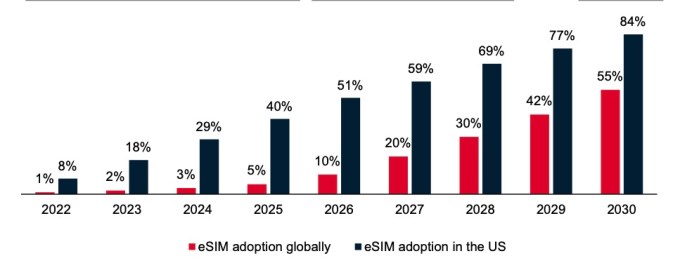
As a technology, eSIM has been around for a decade now. However, global eSIM adoption was around 3% last year and will only cross 5% this year.
Despite these figures, analysts, eSIM-providing startups, and investors are bullish about eSIM’s upward trajectory, largely thanks to travel.
One of the key factors for that is phone makers launching devices with eSIM features.
The first batch of smartphones with eSIM arrived in 2017 and 2018, with the Pixel 2 and the iPhone XR among the most notable phones. In 2022, Apple ditched the physical SIM slot to go eSIM-only for the U.S. market, and Google followed suit with the Pixel 10 this year.
This year, Apple upped the ante by releasing the eSIM-only iPhone Air and offering an eSIM-only model of the iPhone 17 series in more than 11 countries as an option. One key advantage of these eSIM-only phones is that they offer slightly larger battery life than the models with a physical SIM slot.
Analytics firm Counterpoint said that in 2024, the penetration of smartphones with eSIM was just 23%. The U.S. is the strongest market for eSIM, with 41% of devices launched in 2024 having eSIM capabilities.
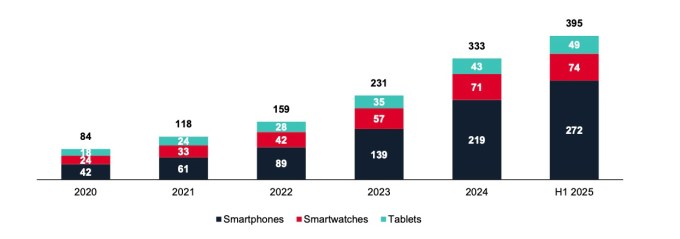
Until recently, eSIM has been a feature of top-end devices, but that is changing slowly. GSMA said that just in the first half of 2025, brands have launched more than 60 eSIM-enabled smartphones.
Techcrunch event
San Francisco
|
October 13-15, 2026
China can be a major factor in eSIM’s adoption. This October, after the launch of Apple’s eSIM-only phone and a few hiccups, China’s telecom providers began offering eSIM support. Pablo Iacopino, an analyst at GSMA, said local manufacturers like Huawei, Xiaomi, Oppo, and Vivo will also likely launch more eSIM-native or supported devices.
These manufacturers have a big share in economically sensitive markets in Asia and Africa. They can gradually include eSIM support across price ranges to support the domestic demand.
“Chinese brands, when they see that the Chinese MNOs have launched eSIM services for the domestic Chinese market, they will probably start introducing eSIM across a wider range of smartphones, including, medium and low-end market,” Iacopino said. “But I don’t think they will go eSIM only immediately. They will start with supporting both physical and eSIM, before shifting to eSIM-only models.”
Currently, even within devices with eSIM support, few people are using the technology — but that’s changing. Steffen Sorrell, head of research at Kaleido Intelligence, a telecom analyst firm, said that it observed a 30% activation rate in devices with eSIM capabilities in 2024. The firm estimates that the rate will go up to 75% by 2030.
While you are traveling, eSIM is one of the most convenient ways to get connectivity. A GSMA survey said that 51% of people using eSIM use it for travel. Plus, it is a more secure solution, given that often eSIM hardware is bound with secure hardware elements, making it difficult to tamper with.
These elements have been positive for eSIM provider startups Airalo, Holafly, eSIM.me, Nomad, and Truely. Even the Lithuania-based security provider Nord launched an eSIM service called Saily. Most of these companies have seen growth in their customer base, and that’s largely thanks to travel.
GSMA said that travel is currently proving to be a strong catalyst for eSIM growth, as frequent travelers prefer to buy devices with eSIM support. Plus, they could adopt eSIM for their long-term usage.
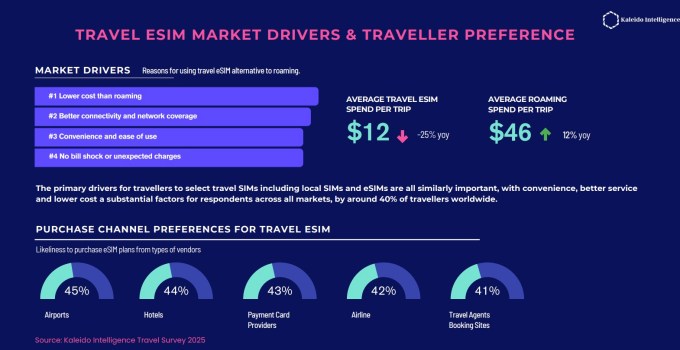
“People might experience eSIM for the first time while traveling. These users who like the eSIM experience would go back home and request their network providers to make a switch from a physical SIM,” GSMA’s Iacopino told TechCrunch over a call.
Airalo is one of the biggest eSIM companies around and has been active for more than six years. The company’s CEO, Bahadir Ozdemir, said that the app is responsible for many users experiencing eSIM for the first time. The company did a survey on its app last year, with 85% of responders being first-time eSIM users.
“Roughly 15% of travel connectivity is being powered by eSIMs, and the number is growing. Once users discover how they can get connectivity with eSIM, they don’t really want to go back to the old way [physical SIMs] of doing it,” Ozdemir noted.
He said that while a lot of telecom operators offer eSIMs, it is not easy for customers to discover those, and apps like Airalo make the process easier. Network providers are also thinking about the travel eSIM market. For instance, Vodafone partnered with UEFA to launch a specialized eSIM for travelers attending football matches across the continent.
Travel-related eSIM startups have seen notable growth. Truely said it has served more than 70,000 travelers over the last two years, with 2x order growth this year. The startup, which raised a $2 million extension round in June, said that apart from partnering with fintech services and travel apps, it is also exploring governmental collaborations in different regions.
NordVPN said that its Saily eSIM app saw a seven-digit user base after its launch in March 2024. The company also launched a $60 per month Ultra plan with global coverage.
Holafly said that it has sold more than 15 million eSIMs since its inception in 2018 and has crossed $500 million in total revenue. The startup noted that out of that figure, it earned $200 million in 2024.
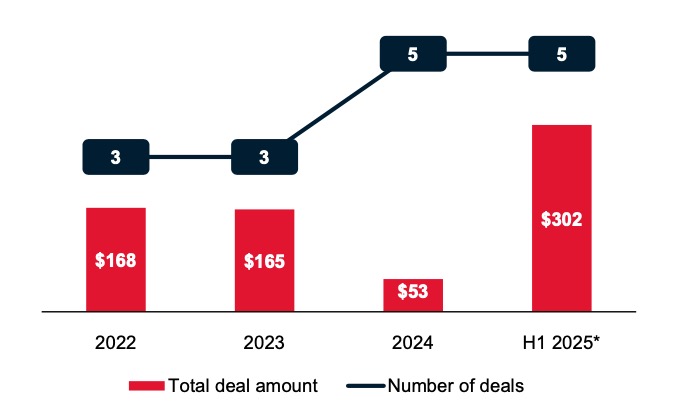
Airalo’s blockbuster $220 million round, led by CVC and announced in July, made it a unicorn and was the most notable eSIM investment in the last two years. Meanwhile, French eSIM startup Kolet nabbed $10 million in Series A funding led by Daphni with participation from former Expedia Group CEO Peter Kern and Apple’s former vice president of marketing Jon Gieselman.
Scott Shiao, a principal at Goodwater Capital, said that the investment concentration will be on travel-related eSIM startups on the consumer side for the time being, but there could be an opportunity in domestic markets in the future as well.
Martell Hardenberg, a partner at Antler, said that while the travel eSIM use case has grown, a lot of users can be considered early adopters, and there is still much room to grow.
“I think there is opportunity in offering bundled services to global travelers or digital nomads about what can companies offer beyond travel SIM cards and make it a lucrative package for these user profiles,” Hardenberg told TechCrunch.
Investors will likely look for offering, marketability for long-term bet as there might be consolidation a few years down the line, Kaledio’s Sorrell said.
“The market is obviously on its way up, but I think sooner or later we’re going to reach a saturation point in terms of the providers on the market there. So investors will look into the long-term viability of the business along with things like customer loyalty, quality of coverage, and even association with marketing capabilities, how you’re able to promote that eSIM, whether it’s through airlines, banks, or cab companies,” he said.
A couple of roadblocks in adoption are education, trust, and ease of use. A lot of people just don’t know what an eSIM is.
“Spotify can tell people to download Spotify because people know about music, and Netflix can tell people to download Netflix because people know about TV shows,” Airalo’s Ozdemir said. “But we couldn’t do that with Airalo, as a lot of people don’t know about eSIMs.”
He noted that the company regularly partners with different influencers to educate people about connectivity on the go through eSIM and redirects them to Airalo.
Truely CEO Eric Dadoun believes that given there is a steady rise in devices that are eSIM only, consumers would be forced to know about the technology as well. He said that companies working in the eSIM industry will still focus on user education for customer acquisition in markets where buying an eSIM-only device is optional.
One of the thornier parts of using an eSIM is that when you buy a plan from any of the apps, you get a QR code in your email that you need to scan to install the eSIM. This means that you need a second device that displays the QR code. The whole process is cumbersome if you are visiting another country and you want to buy an eSIM when you are at an airport.
GSMA’s Iacopino agreed that the process is cumbersome for many users, and as adoption grows, eSIM providers and hardware makers will need to figure out a way to make the process smooth.
Kaleido Intelligence’s Sorrell noted that for some network providers, the move to eSIM is slower, as they have legacy technology and systems that are proving to be a roadblock. They would also need to make the process of switching to this tech fully digital so customers don’t have to visit a store.
Keep reading the article on Tech Crunch