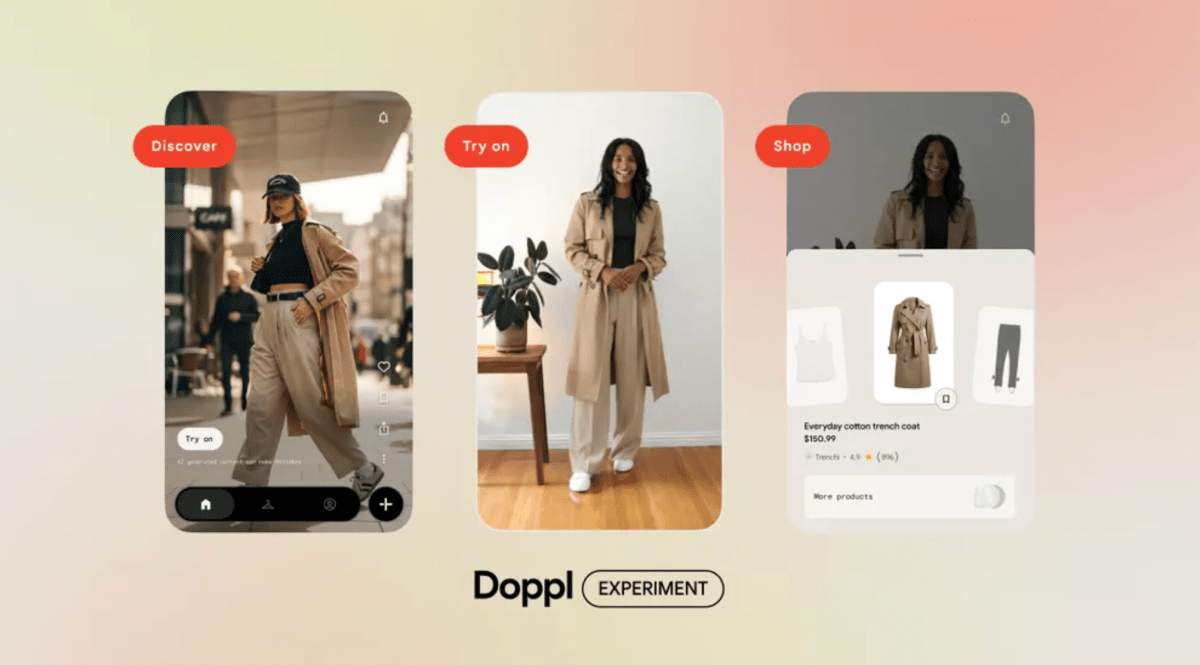
Google announced on Monday that it’s introducing a shoppable discovery feed in Doppl, its experimental app that uses AI to visualize how different outfits might look on you.
The tech giant says the idea behind the new feed is to display recommendations so users can discover and virtually try on new items. Nearly everything in the feed is shoppable, with direct links to merchants.
The discovery feed features AI-generated videos of real products and suggests outfits based on your personalized style. Google determines your style by analyzing the preferences you share with Doppl and the items you interact with.
The move comes as short-form video feeds, particularly on TikTok and Instagram, have conditioned users to scroll visual feeds and buy what they see. However, unlike on TikTok and Instagram, where real influencers showcase products, Google’s new feed only consists of AI-generated content.
While some may not be fond of an AI-generated feed, Google likely sees it as a way to surface products in a format that people are already used to. Plus, it makes sense for the company to try a new e-commerce strategy, especially as it continues to lose ground to companies like Amazon and social media platforms.
It’s worth noting that AI-generated videos aren’t new to Doppl. While the app creates images of a virtual version of yourself wearing different outfits, it can turn these static images and convert them into AI-generated videos. The purpose of this is to give you a better sense of how the outfit would look on you in real life.
The new discovery feed is rolling out to Doppl on iOS and Android in the U.S. for users 18 and above.
Techcrunch event
San Francisco
|
October 13-15, 2026
Although a feed consisting solely of AI-generated content would have seemed strange a year ago, the idea is now gaining traction. For example, OpenAI in September launched Sora, a social media platform of just AI videos. Meta also has a short-form video feed of AI-generated videos called “Vibes” in the Meta AI app.
Keep reading the article on Tech Crunch

Take a look at Project Aura’s computing puck.
An increasing number of browsers are experimenting with agentic features that will take actions on your behalf, such as booking tickets or shopping for different items. However, these agentic capabilities also come with security risks that could lead to loss of data or money.
Google detailed its approach to handling user security on Chrome using observer models and consent for user action. The company previewed agentic capabilities on Chrome in September and said these features will roll out in the coming months.
The company said it is using the help of a few models to keep agentic actions in check. Google said it built a User Alignment Critic using Gemini to scrutinize the action items built by the planner model for a particular task. If the critic model thinks that the planned tasks don’t serve the user’s goal, it asks the planner model to rethink the strategy. Google noted that the critic model only sees the metadata of the proposed action and not the actual web content.
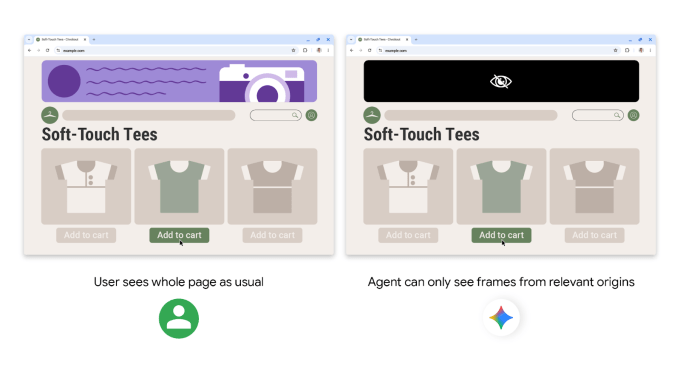
What’s more, to prevent agents from accessing disallowed or untrustworthy sites, Google is using Agent Origin Sets, which restrict the model to access read-only origins and read-writeable origins. Read-only origin is data that Gemini is permitted to consume content from. For instance, on a shopping site, the listings are relevant to the task, but banner ads aren’t. Similarly, Google said the agent is only allowed to click or type on certain iframes of a page.
“This delineation enforces that only data from a limited set of origins is available to the agent, and this data can only be passed on to the writable origins. This bounds the threat vector of cross-origin data leaks. This also gives the browser the ability to enforce some of that separation, such as by not even sending to the model data that is outside the readable set,” the company said in a blog post.
Google is also keeping a check on page navigation by investigating URLs through another observer model. This can prevent navigation to harmful model-generated URLs, the company said.
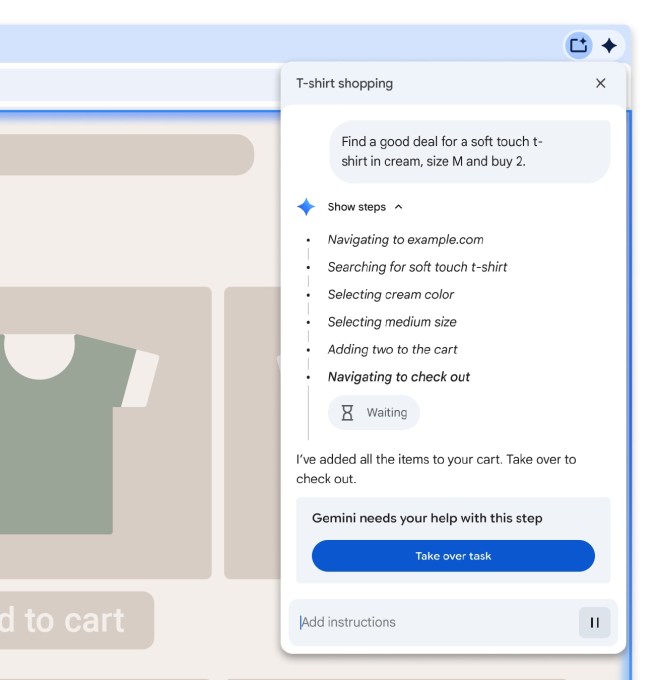
The search giant said that it is also handing over the reins to users for sensitive tasks. For instance, when an agent tries to navigate to a sensitive site with information like banking or your medical data, it first asks the user. For sites that require sign-in, it’ll ask the user for permission to let Chrome use the password manager. Google said that the agent’s model doesn’t have exposure to password data. The company added that it will ask users before taking actions like making a purchase or sending a message.
Techcrunch event
San Francisco
|
October 13-15, 2026
Google said that, in addition to this, it also has a prompt-injection classifier to prevent unwanted actions and is also testing agentic capabilities against attacks created by researchers.
AI browser makers are also paying attention to security. Earlier this month, Perplexity released a new open-source content detection model to prevent prompt injection attacks against agents.
Keep reading the article on Tech Crunch
ChatGPT’s growth is starting to taper off, according to new data from market intelligence firm Sensor Tower. Today, the OpenAI-owned AI chatbot remains the leader in the space, accounting for 50% of global downloads on mobile devices and 55% of the global monthly active users. However, Google’s Gemini has begun to outpace ChatGPT in terms of download growth, growth of monthly active users, and growth of time spent in app, the firm found.
Over time, that increased pace of adoption could help Gemini narrow the gap with ChatGPT. That’s something OpenAI is now worried about, as its recent “code red” memo indicated. The missive, penned by OpenAI CEO Sam Altman, instructed staff to focus on improving the company’s AI products, particularly in areas like personalization, reliability, image generation, and more.
When looking at the recent data, it’s clear the race is not over yet: Both ChatGPT and Gemini continue to see sizable growth.
ChatGPT has seen its global monthly active users climb by 180% year-over-year as of November 2025, while Gemini’s monthly active users are up 170%.
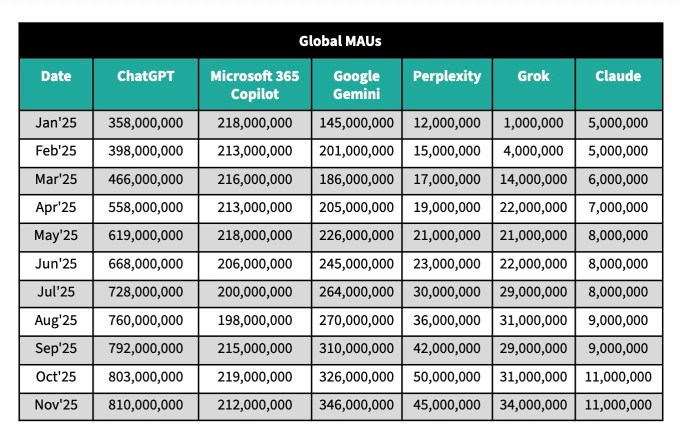
But the new data indicates that ChatGPT’s global monthly active users only grew by around 6% from August to November, to reach roughly 810 million. (The monthly active user numbers in the above chart are rounded, the firm notes.) This figure could suggest the AI chatbot is nearing market saturation, Sensor Tower says.
Meanwhile, Google Gemini’s global monthly active users jumped by around 30% during the same time frame, as the release of its new image generation model, Nano Banana, drove increased adoption.
In addition, the report noted that around two times more U.S. Android users now engage with Gemini directly through the Android operating system compared with using the standalone Gemini mobile app. This could provide Google with a competitive advantage in the global market, where Android dominates, as it means Gemini isn’t constrained to only being used within a mobile app or web interface.
Techcrunch event
San Francisco
|
October 13-15, 2026
Gemini is also increasing its share of the overall AI chatbot market when compared across all top apps like ChatGPT, Copilot, Claude, Perplexity, and Grok. Over the past seven months (May-November 2025), Gemini increased its share of global monthly active users by three percentage points, the firm estimates.
But ChatGPT saw its share of global monthly active users drop three percentage points over the past four months (August-November 2025), by comparison.
Challenges from Perplexity and Claude may also be impacting ChatGPT, as both rivals saw triple-digit growth for their respective chatbots in 2025, with the former up 370% year-over-year, and the latter up 190%.
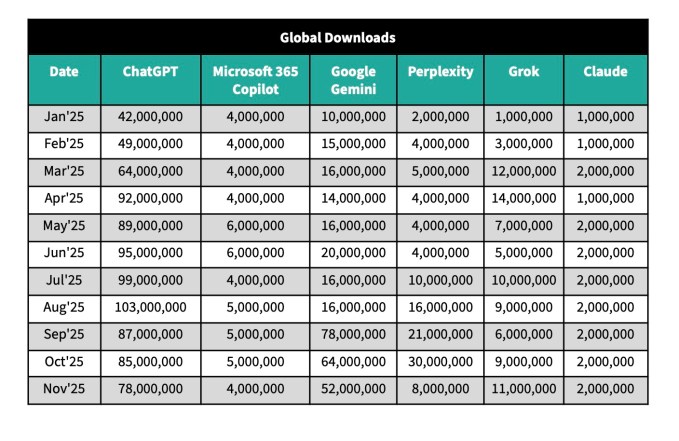
ChatGPT also saw its global downloads grow by 85% year-over-year as of November, but this lagged the overall cohort’s average growth of 110%.
Perplexity and Gemini saw the largest growth, up 215% and 190% year-over-year, respectively.
Finally, Gemini app users’ time spent in the app has more than doubled over the past few months, Sensor Tower said. As of November, Gemini users were spending 11 minutes per day in the app, up 120% from March. This is likely due to the popularity of its image generation model, Nano Banana, in September.
ChatGPT’s users’ daily time spent only increased by 6% during the same time frame. Plus, ChatGPT users’ time spent was down 10% in November, compared with July.
While the current data indicates Google could be catching up with the market leader, much of its recent gains have to do with the success of Nano Banana. OpenAI could speed up growth again with the release of its own new products, if they make a similar impact.
Keep reading the article on Tech Crunch