
Sheena Leven says she learned two important lessons when building her first company, CodeSee. The first lesson was knowing the difference between what businesses need versus what sounds visionary; the second was that the fundamentals always apply, even with new technologies such as AI.
“Security, compliance, reliability, quality, those things don’t just go away for enterprise applications,” she said.
After CodeSee was acquired in 2024, Leven decided that she wanted to build a product that would let business owners, even those without technical backgrounds, build AI applications. She teamed up with AI researcher Sean Robinson, and last October, the two launched Empromptu, an AI service that businesses can use to build AI applications.
Empromptu claims all a user has to do is tell the platform’s AI chatbot what they want — like a new classification app or a generative recommendation app — and the tool will go ahead and build it. It also provides LLM tools to help users if they want to fine-tune any results, and also lets companies add AI features to their own existing code bases.
Leven doesn’t consider it a vibe-coding platform, though she does look to compete with companies like Replit and Lovable.
“Vibe coding is excellent for quick experiments, but Empromptu is what turns those experiments into real software,” she said. Empromptu, she continued, “turns ideas into production features with built-in evaluation, governance, and self-improvement,” she said. “You ship to real customers, with real data and complete control. If vibe coding is the brainstorm, Empromptu is the build.”
On Tuesday, the company said it had raised $2 million in a pre-seed funding round led by Precursor Ventures. Zeal Capital, Alumni Ventures, Founders Edge and South Loop also participated.
Techcrunch event
San Francisco
|
October 13-15, 2026
Leven said the fresh capital will be used for hiring staff and developing new proprietary technology.
The company is hoping to target businesses launching in regulated industries or “deeply complex” areas that involve capturing data and creating applications — software that services hotels, for example.
Overall, Leven hopes that founders feel their businesses can be transformed without having to learn the technical skills to take advantage of the AI revolution.
“It’s just like any other skill,” Leven said. “And the beauty of this skill is that AI can help you learn it along the way.”
This piece was updated to clarify what Empromptu does.
Keep reading the article on Tech Crunch
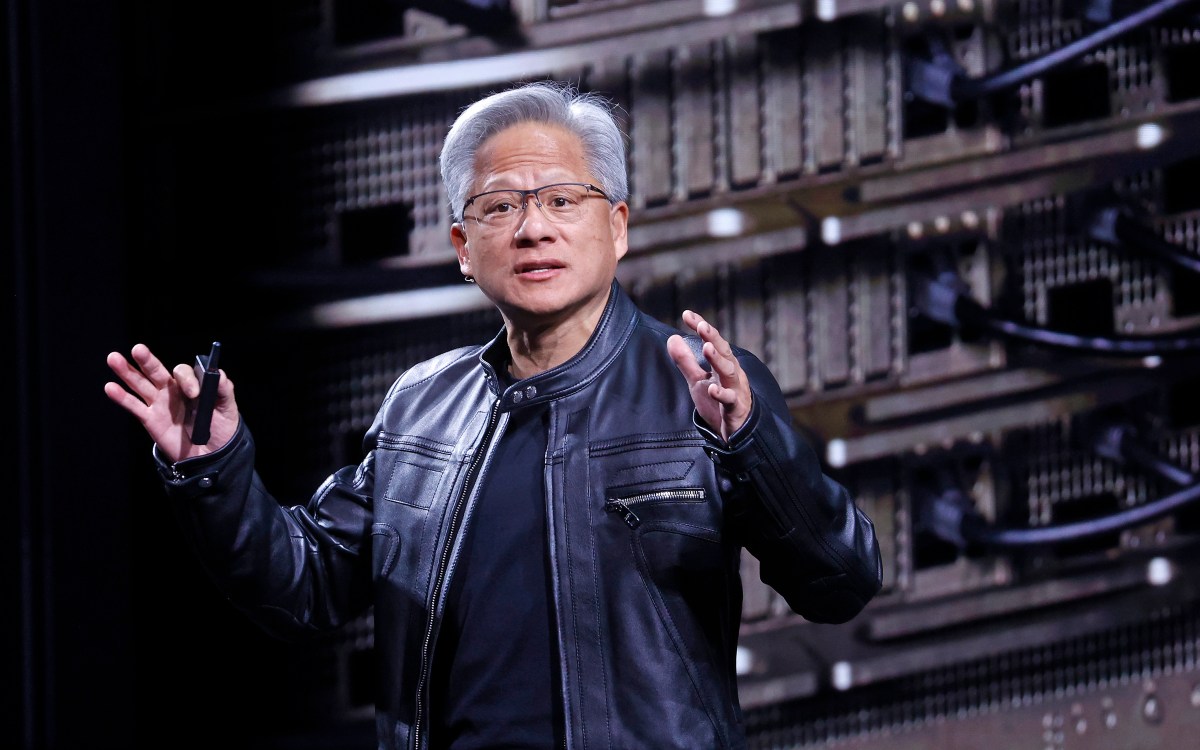
Advanced Nvidia AI chips can head back to China after all.
The Department of Commerce will allow Nvidia to ship H200 chips to China, as originally reported by Semafor, to approved customers in the country. The U.S. will take a 25% cut of these sales, CNBC reported.
H200 chips are much more advanced than the H20 chips Nvidia developed specifically for the Chinese market, but the company would only be able to send H200s that are roughly 18 months old, Semafor reported.
“We applaud President Trump’s decision to allow America’s chip industry to compete to support high paying jobs and manufacturing in America. Offering H200 to approved commercial customers, vetted by the Department of Commerce, strikes a thoughtful balance that is great for America,” an Nvidia spokesperson told TechCrunch.
The news report comes a week after U.S. Commerce Secretary Howard Lutnick said the decision on exporting these H200 chips to China was in President Donald Trump’s hands.
The decision to send these chips to China conflicts with Congressional concerns about national security.
Pete Ricketts, a Republican senator from Nebraska, and Chris Coons, a Democratic senator from Delaware, introduced a bill on December 4 that would block the export of advanced AI chips to China for more than two years.
Techcrunch event
San Francisco
|
October 13-15, 2026
The Secure and Feasible Exports Act (SAFE) Chips Act would require the Department of Commerce to deny any export license on advanced AI chips to China for 30 months. It’s unclear when legislators will vote on the proposed bill especially now that the Trump administration has given the green light to sell the H200 chips.
While Congress has long been clear about sending advanced AI chips to China — on both sides of the aisle — President Trump has waffled on whether or not to allow the exports.
The Trump administration hit chip companies like Nvidia with licensing requirements to send their chips to China in April before it formally rescinded a Biden administration diffusion rule that would have regulated AI chip exports in May. Over the summer, the U.S. government signaled that companies would be able to start sending chips to China as long as the government got a 15% cut of all revenue, as chips became a bargaining tool in trade talks with China.
However, by that point, the market for U.S.-developed chips in China was strained.
In September, China’s internet regulator, the Cyberspace Administration of China, banned domestic companies from buying Nvidia’s chips, leaving companies in the country to rely on less advanced domestic chips from Alibaba and Huawei.
On Monday, Trump said that Chinese president Xi Jinping “responded positively” to the latest H200 news in a Truth Social post.
This story was updated on December 8 when the proposed decision was confirmed.
Keep reading the article on Tech Crunch

As energy demand for data centers soars, environmental groups are calling for a moratorium on the approval and construction of new facilities.
More than 230 organizations, including Food & Water Watch, Friends of the Earth, and Greenpeace signed a public letter urging members of Congress to support a national moratorium on the approval and construction of new data centers, citing rising electricity and water consumption.
“The rapid, largely unregulated rise of data centers to fuel the AI and crypto frenzy is disrupting communities across the country and threatening Americans’ economic, environmental, climate and water security,” the letter reads.
Several studies have linked higher energy prices to the arrival of new data centers in a region. Consumers have been arriving at similar conclusions: A recent survey, commissioned by solar installer Sunrun, found that eight in 10 consumers were worried about data centers negatively affecting their utility bills.
Electricity prices have already shot up 13% this year, bigger than any annual increase in the past decade.
The effects are expected to be felt most in a handful of states, including Virginia, Pennsylvania, Ohio, Illinois, and New Jersey, which are slated for the largest increase in data center capacity.
Energy demand for data centers is expected to nearly triple in the coming decade, up from 40 gigawatts today to 106 gigawatts in 2035. Much of that will take place in rural areas.
Techcrunch event
San Francisco
|
October 13-15, 2026
“All this compounds the significant and concerning impacts AI is having on society, including lost jobs, social instability and economic concentration,” the environmental groups said.
Proposed data centers have become a flash point in recent days.
Last week, protestors marched outside the headquarters of utility DTE in Detroit. The company is requesting approval from the Michigan Public Service Commission to supply OpenAI and Oracle with electricity for a 1.4 gigawatt data center. Protestors said they were concerned about the data center driving up electricity bills, using too much fresh water, and snarling traffic.
Also last week, three people were arrested in Wisconsin during a common council meeting about a 902 megawatt data center that’s slated to be part of OpenAI and Oracle’s Stargate project.
Keep reading the article on Tech Crunch

IBM is buying data infrastructure company Confluent for $11 billion in cash in a bid to bolster its data and automation products as ever more companies move their tech operations to the cloud and deploy AI technology.
The tech giant said it would offer $31 for each Confluent share, which is about 50% more than what the smaller company’s shares closed at on Friday, before news of the deal.
Confluent offers a platform that helps enterprises manage streams of data in real time, a use case that’s exploded in demand as ever more companies develop and deploy AI products, which require significant back-and-forth processing of data for inferencing.
IBM said Confluent will complement its existing data and automation products, as well as improve upon its existing offerings across AI, automation, data, and consulting. The company expects the deal to add to EBITDA and free cash flow in the two years after the deal is closed.
This is the latest in a string of deals IBM has struck in recent months as it seeks to capitalize on the AI boom, though at $11 billion, Confluent would be the tech giant’s largest buy in years, following its acquisition of HashiCorp in 2024.
IBM in October signed a deal with AI lab Anthropic to deploy the Claude large language model into some of its products; it has partnered with AMD to develop a new computing architecture that combines quantum systems with AI-specialized chips; and it acquired data analysis startup Seek AI in June.
Techcrunch event
San Francisco
|
October 13-15, 2026
Keep reading the article on Tech Crunch
OpenAI released new data Monday showing enterprise usage of its AI tools has surged dramatically over the past year, with ChatGPT message volume growing 8x since November 2024 and workers reporting they’re saving up to an hour daily. The findings arrive a week after CEO Sam Altman sent an internal “code red” memo about the competitive threat of Google.
The timing underscores OpenAI’s push to reframe its position as the enterprise AI leader, even as it faces mounting pressures. While close to 36% of U.S. businesses are ChatGPT Enterprise customers compared to 14.3% for Anthropic, per Ramp AI Index, the majority of OpenAI’s revenue still comes from consumer subscriptions — a base that’s being threatened by Google’s Gemini. OpenAI also must compete against rival AI firm Anthropic — whose revenue comes mainly from B2B sales – and, increasingly, open-weight model providers for enterprise customers.
The AI giant has committed $1.4 trillion to infrastructure commitments over the next few years, making enterprise growth essential to its business model.
“If you think about it from an economic growth perspective, consumers really matter,” Ronnie Chatterji, OpenAI’s chief economist, said during a briefing. “But when you look at historically transformative technologies like the steam engine, it’s when firms adopt and scale these technologies that you really see the biggest economic benefits.”
OpenAI’s new findings suggest that adoption among larger enterprises is not only growing but becoming more integrated into workflows. Employees aren’t only sending more messages — organizations using OpenAI’s API (its developer interface) are consuming 320 times more “reasoning tokens” than they were a year ago, suggesting companies are using AI for more complex problem-solving. That, or they are experimenting heavily with the new tech and burning through tokens, without necessarily getting long-term value.
That increase in reasoning tokens, which correlates with increased energy usage, could be expensive for companies and therefore not sustainable in the long term. TechCrunch has asked OpenAI about enterprise budget allocation for AI and the sustainability of this growth rate.
Beyond raw usage metrics, OpenAI is also seeing changes in how companies deploy its tools. Use of custom GPTs — which companies use to codify institutional knowledge into assistants or automate workflows — jumped 19x this year, now accounting for 20% of enterprise messages, the report found. OpenAI pointed to digital bank customer BBVA, which it says regularly uses over 4,000 custom GPTs.
Techcrunch event
San Francisco
|
October 13-15, 2026
“It shows you how much people are really able to take this powerful technology and start to customize it to the things that are useful to them,” said Brad Lightcap, OpenAI’s chief operating officer, during the briefing.
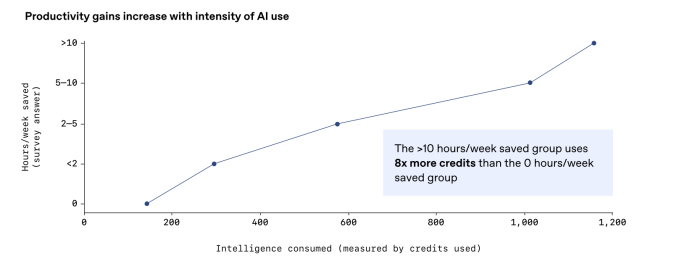
These integrations have led to meaningful time savings, according to OpenAI. Participants reported saving 40 to 60 minutes per day with OpenAI’s enterprise products — though that may not include time spent learning the systems, prompting, or correcting AI output.
The report found that enterprise workers are also increasingly leveraging AI tools to expand their own capabilities. Three quarters of those surveyed say AI enables them to do things, including technical tasks, they couldn’t do before. OpenAI reported a 36% increase in coding-related messages outside of engineering, IT, and research teams.
While OpenAI drove home the idea that its technology is democratizing access to skills, it’s important to note that more vibe coding could lead to more security vulnerabilities and other flaws. When asked about this, Lightcap pointed to OpenAI’s recent release of its agentic security researcher Aardvark, which is in private beta, as a potential way to detect bugs, vulnerabilities, and exploits.
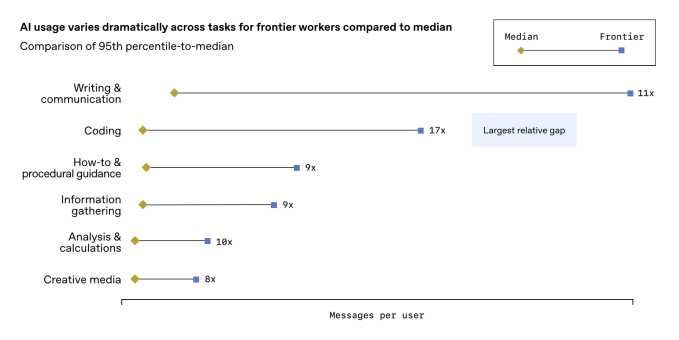
OpenAI’s report also found that even the most active ChatGPT Enterprise users aren’t using the most advanced tools available to them, like data analysis, reasoning, or search. During the briefing, Lightcap mused that this was because fully adopting AI systems requires a mindset shift and deeper integration with enterprise data and processes. Adoption of advanced features will take time, he said, as companies retool workflows to better understand what’s possible.
Lightcap and Chatterji also stressed a report finding that showed a “growing divide in AI adoption,” with some “frontier” workers using more tools more often to save more time than the “laggards.”
“There are firms that still very much see these systems as a piece of software, something I can buy and give to my teams and that’s kind of the end of it,” Lightcap said. “And then there are companies that are really starting to embrace it, almost more like an operating system. It’s basically a re-platforming of a lot of the company’s operations.”
OpenAI’s leadership — which certainly feels the pressure of the firm’s $1.4 trillion in infrastructure commitments — framed this as an opportunity for laggards to catch up. For workers training AI systems to replicate their work, “catching up” might feel more like a countdown.
Keep reading the article on Tech Crunch
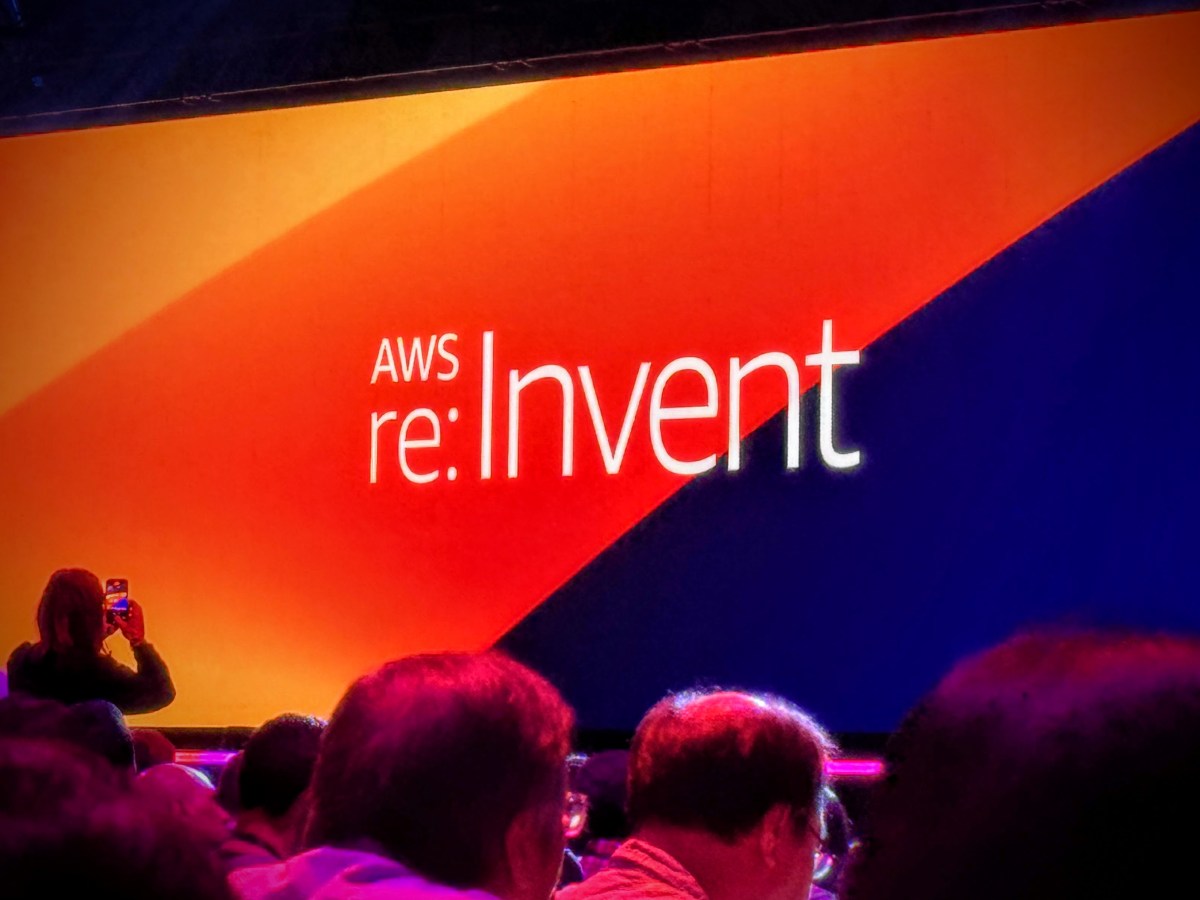
If Amazon Web Services’ annual re:Invent tech conference proves anything, it’s that the cloud infrastructure player is going all in on AI.
AWS announced made dozens of announcements from new AI agents and updated large language models, to products with LLM and agent-building capabilities. AI for enterprise was everywhere. But are its customers just as eager?
AWS CEO Matt Garman acknowledged during his keynote that enterprises haven’t seen a return on AI investment yet. He thinks that’s about to change — and fast.
“I believe that the advent of AI agents has brought us to an inflection point in AI’s trajectory,” Garman said. “It’s turning from a technical wonder into something that delivers us real value. This change is going to have as much impact on your business as the internet or the cloud.”
While analysts told TechCrunch they were impressed by some of AWS’ tech announcements this week, they aren’t sure it’s enough to move the needle on enterprise AI adoption or change AWS’ position in the AI race.
AWS is one of the market leaders when it comes to cloud infrastructure; the same can’t be said for its enterprise AI offerings.
Anthropic, OpenAI, and Google hold a commanding lead when it comes to enterprise market share for actual AI models. AWS does have the advantage of having everything in house, including infrastructure and its own AI training chips.
Techcrunch event
San Francisco
|
October 13-15, 2026
Naveen Chhabra, a principal analyst at Forrester, told TechCrunch over email that while AWS announced a lot of cool new technology, it doesn’t change the fact that many enterprises aren’t ready to adopt AI.
“AWS AI announcements show that AWS is thinking ahead and maybe far too ahead,” Chhabra wrote. “Most enterprises are still piloting AI projects and are rarely at the levels of maturity AWS expects them to be to take advantage of the offerings that come out of these announcements.”
A widely cited MIT study from August found that 95% of enterprises aren’t seeing a return on investment from AI.
Ethan Feller, an equity strategist at Zacks Investment Research, told TechCrunch in a phone interview that the new Nova AI models, agents, and model-building capabilities weren’t what stood out to him as interesting from this week — despite these being the products AWS hyped the most. Instead, it was the infrastructure announcements.
“The AWS AI factory is really compelling,” Feller said about a new initiative that allows customers to run AWS AI in their own data centers. “AWS is a huge player in where the models are being run and is dominant in the cloud industry. I think that is where Amazon’s expertise really lies. It’s a good thing to double down on where they have expertise.”
Feller likes that AWS is looking to make a vertical AI play, but he thinks it may make more sense to do so through partnerships with other AI players like Anthropic and Nvidia as opposed to using all of their own AI technology.
Despite all of this, AWS is still well positioned to carve out market share in the AI sector, while continuing to grow its core businesses.
AWS’ position as an industry-leading cloud provider means it has a solid business foundation despite what happens in the AI market because it provides the rails for the industry’s technology — regardless of what the AI trend of the moment is.
If the AI industry ends up being the bubble some say it is, AWS, which recorded $11.4 billion in operating income in the third quarter, will likely be less affected by a negative change in AI market conditions than its peers.
This gives AWS room to experiment and iterate on what its place in the AI market could look like down the road. That’s why even if enterprises aren’t ready for the tech they release today, AWS should keep working to improve it.
Follow along with all of TechCrunch’s coverage of the annual enterprise tech event here, and see all the announcements you may have missed thus far here.
Keep reading the article on Tech Crunch